Portions · per person
How much rice, pasta and meat per person?
Our example recipes allocate 100 g (3.5 oz) of dry pasta, 75 g (2.6 oz) of uncooked rice or 125 g (4.4 oz) of raw meat per serving. These are recipe inputs for demonstrating scaling, not recommended intakes. For comparison, the U.S. label reference amounts used here are 55 g of dry pasta, 45 g of dry rice and 114 g of raw meat. Pasta and rice in a main dish come to about 1.7–1.8 label servings; meat is close to one.
The amount to cook depends on the recipe, other dishes and the people eating. The numbers below explain our examples; they are not a universal portion guide. "Serving" also has different meanings: One is the serving size printed on the package, which U.S. regulations fix so that nutrition labels can be compared. The other is what a recipe gives each person at dinner. For pasta and rice they differ by 1.7 to 1.8 times.
The label serving: fixed by regulation
Package serving sizes in the U.S. are based on "reference amounts customarily consumed" (RACC), set by the FDA for most foods and by the USDA for meat and poultry. The ones that matter for a dinner plan:
| Food | Reference amount | Rule |
|---|---|---|
| Pasta, plain | 55 g dry · 140 g prepared | 21 CFR 101.12 |
| Rice and other plain grains | 45 g dry · 140 g prepared | 21 CFR 101.12 |
| Beans, plain (we compare red lentils with this row) | 35 g dry · 90 g prepared | 21 CFR 101.12 |
| Meat, cuts without sauce | 114 g ready-to-cook · 85 g ready-to-serve | 9 CFR 317.312 |
| Poultry, cuts without sauce | 114 g ready-to-cook · 85 g ready-to-serve | 9 CFR 381.412 |
| Fish and shellfish without sauce | 110 g uncooked · 85 g cooked | 21 CFR 101.12 |
| Soups, all varieties | 245 g | 21 CFR 101.12 |
The previous, 2020–2025 edition of the Dietary Guidelines counted grains in ounce-equivalents: "1 ounce dry pasta or rice" or "½ cup cooked rice, pasta" is one ounce-equivalent, and its 2,000-calorie pattern has 6 a day. The current 2025–2030 guidelines count servings instead (½ cup of cooked grains is one serving).
The dinner serving: what our recipes use
Our example recipes are written for main meals. Divide each recipe's amount by the number of people it serves:
| Recipe | Ingredient | Recipe amount | Per person | Label servings |
|---|---|---|---|---|
| Tomato pasta (serves 4) | pasta, dry | 400 g | 100 g | 1.82 (÷ 55 g) |
| Chicken rice bowl (serves 4) | rice, uncooked | 300 g | 75 g | 1.67 (÷ 45 g) |
| Chicken rice bowl (serves 4) | chicken thighs, raw | 500 g | 125 g | 1.10 (÷ 114 g) |
| Big-batch chili (serves 8) | beef mince, raw | 1 kg | 125 g | 1.10 (÷ 114 g) |
| Red lentil soup (serves 6) | red lentils, dry | 300 g | 50 g | 1.43 (÷ 35 g) |
| Chicken noodle soup (serves 4) | egg noodles, dry | 200 g | 50 g | 0.91 (÷ 55 g) |
In these examples, the pasta and rice quantities are close to two label reference amounts. The noodle quantity in the example soup is below one. This comparison describes the recipes, not what a dinner portion should be. Meat is 1.10 label servings in both recipes. In the 2020–2025 guidelines' terms, 100 g of dry pasta is 100 ÷ 28.35 = 3.5 ounce-equivalents, a bit over half of that pattern's 6 a day in one bowl.
Scale these examples by headcount
Multiply the example inputs below only if those are the recipe quantities you want to use. The table is arithmetic, not a dietary recommendation:
| People | Dry pasta | Uncooked rice | Raw meat or poultry |
|---|---|---|---|
| 2 | 200 g | 150 g | 250 g |
| 4 | 400 g | 300 g | 500 g |
| 6 | 600 g | 450 g | 750 g |
| 8 | 800 g | 600 g | 1000 g |
| 10 | 1000 g | 750 g | 1250 g |
Rice is measured uncooked here. The label reference for cooked rice is 140 g against 45 g dry, about three times the weight, so check which one a recipe means before scaling.
Scaling examples and purchase rounding
To calculate proportional recipe quantities, multiply every measured ingredient by servings wanted ÷ servings in the recipe. Keep that calculated need separate from the rounded shopping display; whole items round up and weights may also be rounded for display. Here is the tomato pasta recipe (serves 4) planned for 2, 4, 6 and 9 people, as the planner computes it:
| Servings | Pasta | Tomatoes | Garlic |
|---|---|---|---|
| 2 | 200 g | 2 | 1 clove |
| 4 | 400 g | 4 | 2 cloves |
| 6 | 600 g | 6 | 3 cloves |
| 9 | 900 g | 9 | 5 cloves (needs 4 ½) |
At 9 servings the garlic needs 2 × 9 ÷ 4 = 4½ cloves, so the list says 5 and keeps "needs 4 ½" beside it. Weights such as parmesan are rounded to the nearest 5 g once they pass 100 g (50 × 9 ÷ 4 = 112.5 g, shown as 115 g).
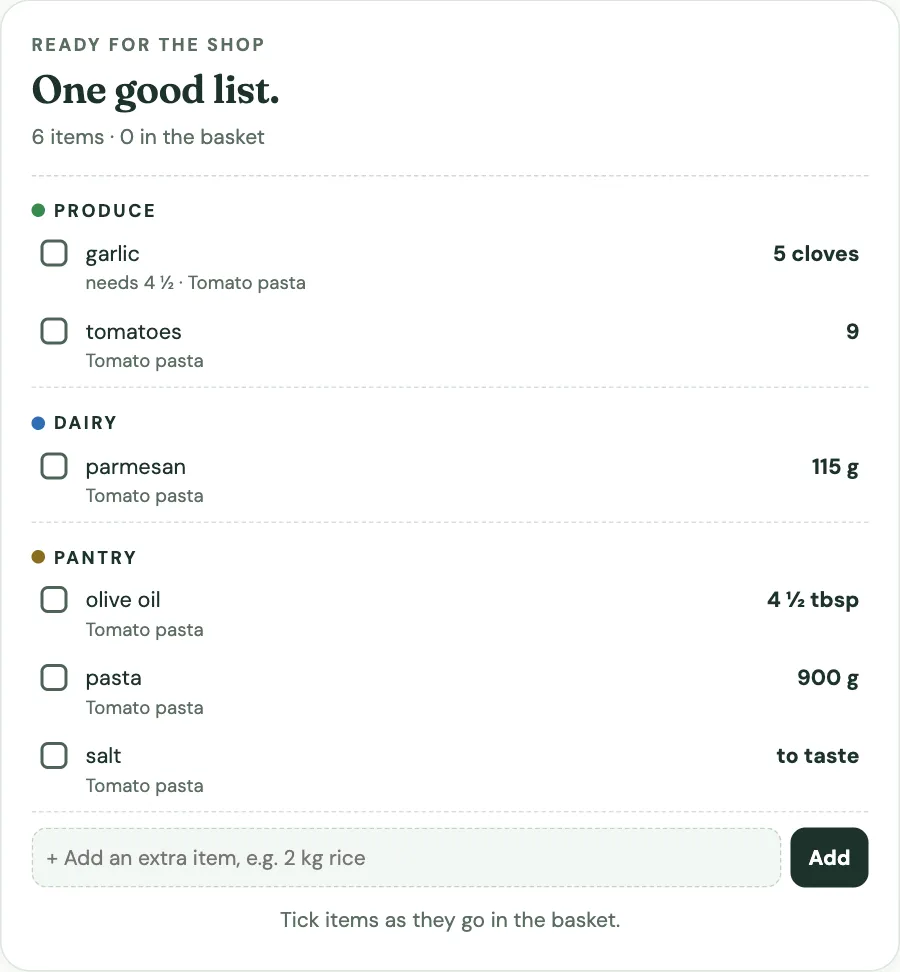
If you're cooking for a crowd, plan the meal at the number of people eating and let the multiplication happen on the list. For the weekly version of this, with every meal at its own servings, see how to make a grocery list from your meal plan.
Questions
How much rice per person?
Our example rice bowl and curry use 75 g (2.6 oz) of uncooked rice per serving. Choose a recipe and portion appropriate to your meal; this is not a recommended intake. The label serving is 45 g dry, set as the reference amount in 21 CFR 101.12.
How much pasta per person?
The example tomato pasta uses 100 g (3.5 oz) dry per serving. That is a recipe input, not a recommended intake; the U.S. label reference amount compared here is 55 g dry.
How much meat per person?
Our example chicken bowl and chili use 125 g (4.4 oz) raw per serving. This is not a recommended intake; the 114 g ready-to-cook figure is a label reference, not a meal target.
How much pasta for 10 people?
Scaling our 100 g-per-serving example to ten gives 1 kg (2.2 lb) dry pasta. Use your own recipe quantities if you want different portions.
Sources
- eCFR, 21 CFR 101.12, Reference amounts customarily consumed per eating occasion (current as of 2026-10-27) — pasta 55 g dry, grains 45 g dry, beans 35 g dry, fish 110 g uncooked, soups 245 g
- eCFR, 9 CFR 317.312, Reference amounts for meat products — meat entrees without sauce 114 g ready-to-cook
- eCFR, 9 CFR 381.412, Reference amounts for poultry products — poultry cuts 114 g ready-to-cook
- Dietary Guidelines for Americans, 2020–2025 (previous edition), Appendix 3 — 1 oz-eq grains = 1 ounce dry pasta or rice; 6 oz-eq grains at 2,000 calories
- Dietary Guidelines for Americans, 2025–2030, Daily Servings by Calorie Level (PDF) — grain servings: ½ cup cooked
- Mintquiet example recipes, run through the planner's own list code — per-person amounts and the scaling table