Leftovers · food safety
How long do leftovers last? Plan them into the week
Cooked leftovers keep 3 to 4 days in the refrigerator (at 40 °F / 4 °C or below, with appropriate handling) and 3 to 4 months in the freezer for best quality at 0 °F / −18 °C or below, according to the USDA's Food Safety and Inspection Service. Refrigerate them within 2 hours of cooking and reheat to 165 °F. Our planning rule on top of that: put any planned repeat within 3 days of cooking day, or freeze a portion the day you cook.
"Cook once, eat twice" means one big pot, two or three meals and a shorter grocery list. It also has a clock attached. The question isn't only how long leftovers last; it's whether the days you planned to eat them fall inside that time. Here is the federal guidance, and a planned week checked against it day by day.
The rules, from FSIS and FoodSafety.gov
| What | Guidance | Source |
|---|---|---|
| Cooked leftovers in the refrigerator | 3 to 4 days | FSIS; FoodSafety.gov chart |
| Soups and stews (vegetable or meat added) | 3 to 4 days refrigerated, 2 to 3 months frozen | FoodSafety.gov chart |
| Cooked meat or poultry leftovers, frozen | 3 to 4 months (FSIS) · 2 to 6 months (FoodSafety.gov), for quality | both |
| Time at room temperature | No more than 2 hours (1 hour above 90 °F) | FSIS |
| Reheating | To 165 °F, measured with a food thermometer | FSIS |
| Refrigerator temperature | 40 °F (4 °C) or below | FoodSafety.gov chart |
The two federal pages give different freezer times for cooked meat: FSIS says 3 to 4 months, the FoodSafety.gov chart 2 to 6 months. FoodSafety.gov makes the condition explicit: food kept continuously frozen at 0 °F (−18 °C) or below can be kept indefinitely; the freezer times in its chart concern quality. Freezing does not make improperly handled food safe. Use the shorter listed quality period if you prefer a conservative plan.
A cook-once week, checked day by day
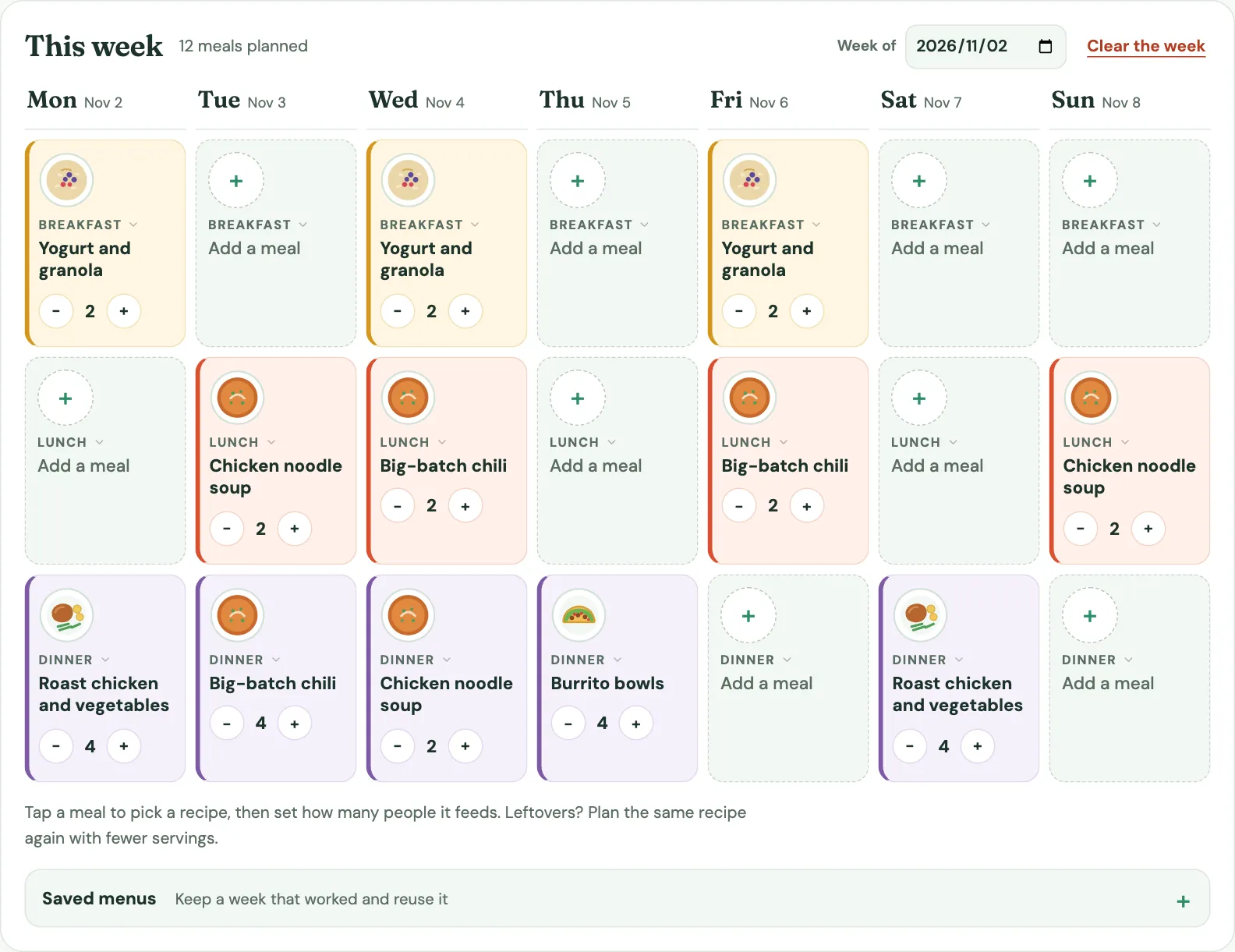
Our "cook once, eat twice" example plans 12 meals from 5 recipes. Four are planned more than once: the yogurt breakfast (not cooked, so it doesn't count here), the roast chicken, the chili and the noodle soup. The chart counts days from cooking day.
cooking dayleftovers, days after cookingoutside 3 to 4 days
- Chili: cook an 8-serving batch Tuesday, serve 4 that evening and eat the reserved portions again Wednesday (+1) and Friday (+3). The planned dates fall inside the window if the food is handled and stored appropriately; the planned servings add up to exactly one 8-serving batch (4 + 2 + 2 = 8).
- Roast chicken: cooked twice, Monday and Saturday, and eaten the same day both times.
- Noodle soup: eaten Tuesday, Wednesday and Sunday. One pot kept from Tuesday to Sunday would be 5 days old, past the 3-to-4-day limit. To use these dates without keeping one pot refrigerated for five days, cook twice: a full pot on Tuesday, a half pot on Sunday. The other option is to freeze Sunday's portion on Tuesday.
The shopping amount supports two cooking sessions; it does not schedule them
The soup recipe serves 4. The week plans it for 2 on Tuesday, 2 on Wednesday, 2 on Sunday: 6 servings, one and a half recipes. The grocery list multiplies by 6 ÷ 4 = 1.5, so it already contains the ingredients for a full pot on Tuesday (eaten Tuesday and Wednesday) and a half pot on Sunday. The planner sums these servings; it does not record when a batch was cooked, monitor storage temperatures or flag unsafe repeats. Cooking twice is a manual decision in this example, not an automatic safety check.
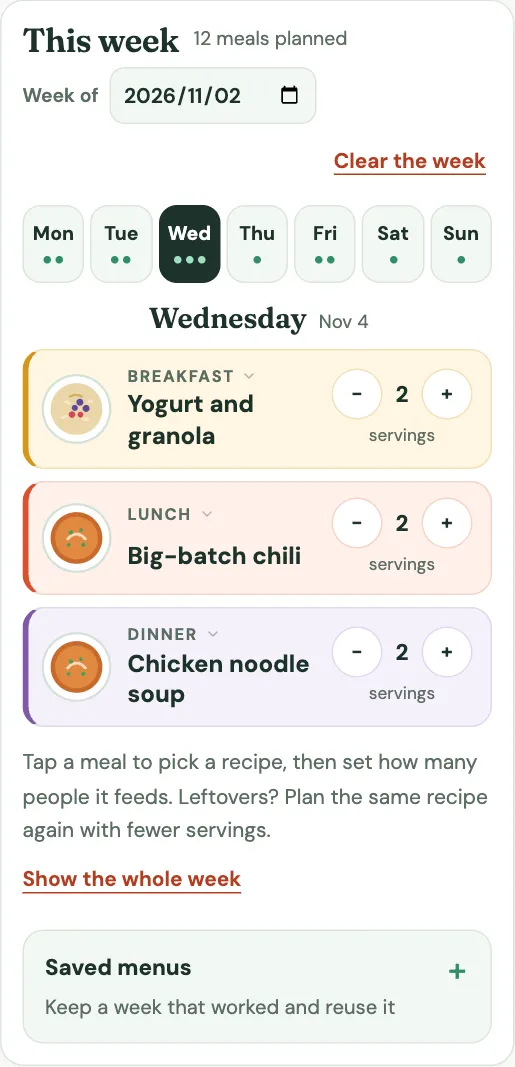
How to plan leftovers that stay inside the window
- Plan the repeat within 3 days of cooking day. Cook on Sunday, eat again by Wednesday. That keeps you at the short end of the 3 to 4 days.
- Set the servings on each repeat. A lunch for 2 from a dinner for 4 is a smaller meal; giving it its own servings keeps the shopping amounts right.
- Reserve and freeze later-week portions on cooking day. This is our conservative planning choice, not a claim that properly refrigerated food must never be frozen later. Follow handling and cooling guidance and keep frozen portions at 0 °F (−18 °C) or below; reheat leftovers to 165 °F.
- Refrigerate within 2 hours. Within 2 hours of cooking, or 1 hour above 90 °F. FSIS advises dividing large amounts of food, such as a pot of chili, into shallow containers so they cool quickly.
- Reheat soups to a boil. FSIS says to reheat sauces, soups and gravies by bringing them to a rolling boil.
The cook-once week also has the shortest grocery list of our three templates: 22 lines against 26 and 33. See the three templates side by side, or how the week compares with the USDA food budgets.
Questions
How long are leftovers good for in the fridge?
3 to 4 days at 40 °F (4 °C) or below, according to the USDA Food Safety and Inspection Service and the FoodSafety.gov storage chart.
How long do leftovers last in the freezer?
FoodSafety.gov says food kept continuously frozen at 0 °F (−18 °C) or below can be kept indefinitely. This assumes safe handling before freezing. Quality guidance varies: FSIS lists 3 to 4 months for leftovers; FoodSafety.gov lists 2 to 6 months for cooked meat or poultry and 2 to 3 months for soups and stews.
How long can leftovers sit out before going in the fridge?
No more than 2 hours at room temperature, or 1 hour when the temperature is above 90 °F.
What temperature should leftovers be reheated to?
165 °F, measured with a food thermometer.
Sources
- USDA FSIS, Leftovers and Food Safety (last updated July 31, 2020) — 3 to 4 days refrigerated, 3 to 4 months frozen, 2-hour rule, shallow containers, reheat to 165 °F, soups to a rolling boil
- FoodSafety.gov, Cold Food Storage Chart (reviewed September 19, 2023) — cooked meat or poultry leftovers 3 to 4 days / 2 to 6 months; soups and stews 3 to 4 days / 2 to 3 months
- Mintquiet cook-once example week, run through the planner's own list code — planned days, servings and list lines